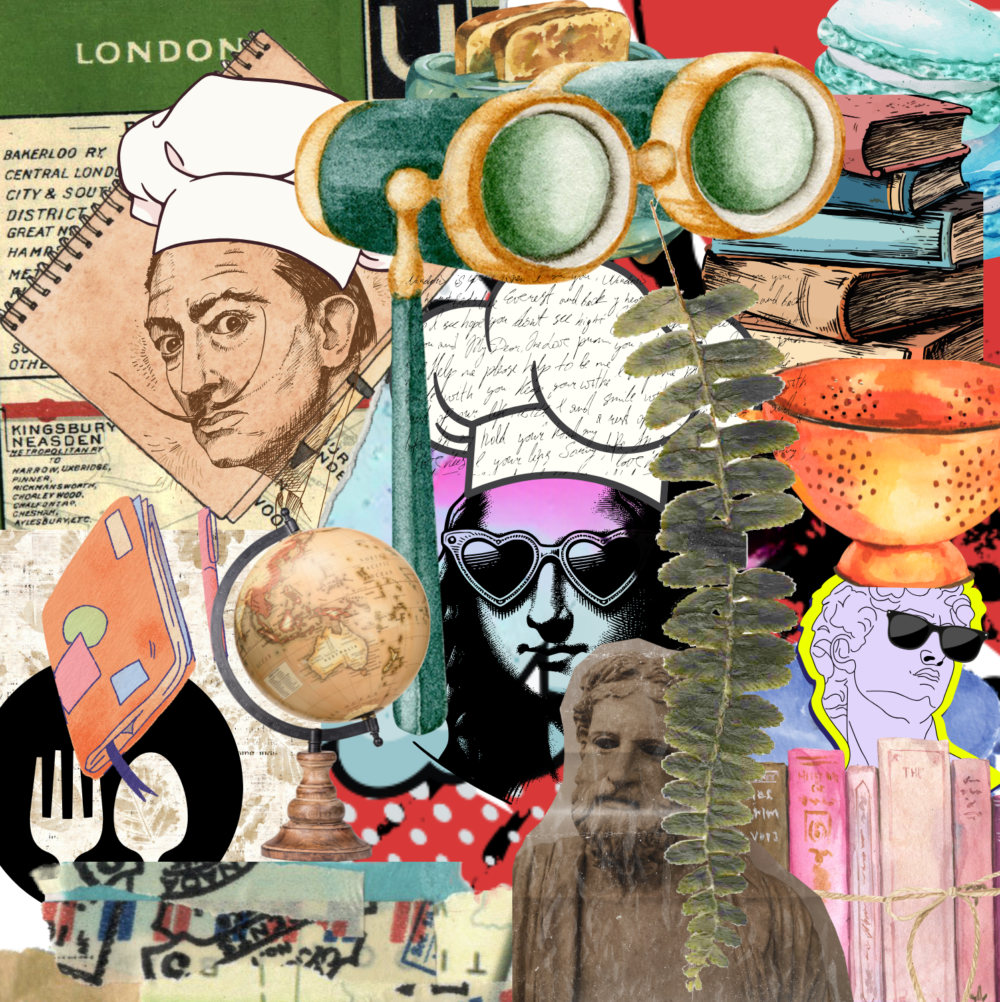

You have officially reached The Gastronaut. However you got here is no coincidence—something will resonate, lovies; you have arrived to my kitchen.
The kouzina is where I spend so much of my time—preparing meals and experimenting with ingredients; creating moments of culinary bliss and mess; and sharing food and conversation with family and friends. Sometimes I’m a kitchen alchemist, and then I am also the kitchen tribal chief.
And what you are reading is my official kitchen table publication coming straight to you not only from my kouzina (koo-zee-na) (this is Greece, so the kitchen is always the kouzina)—but from ‘the table.’
It isn’t just ‘a table’; it has become ‘the table’ because it has witnessed many juicy meals and juicy conversations. Ah, if tables could talk, this one would have tons to divulge. It would be the great reveal. Trust me. It’s Greece. You won’t believe what is discussed over anything edible.
But beyond the nurturing and nourishing lovingly “cooked” up in the kitchen, my kitchen table is my creative nook. And when I am not cooking, when we are not eating at the table, that table is reserved. For my writing.
It is where I write.
Working on my books and writing in creative journals is only done at THE TABLE: notebooks, laptop, coffee, whatever strikes my fancy on a plate, my bottle of water, phone, and anything else ‘necessary’ right here (except for anything smokable—that has to be done outside), lovies, are strewn across the table—the hub of things, the kitchen.
The Inner Workings of My Kouzina.
My kitchen, like everything else in my life, is run and managed using an age-old Greek practical guide—a built-in tool we all have known as Me to Mati (using the eye).
Many things in life need to be measured in specific quantities, such as doses of medicine, the substances used in lab experiments, or when accuracy is required in technical and scientific procedures. But this practice of specifying exact measurements and quantities spills out in many everyday moments of Western life—
Oh seriously, we are timing everything and weighing everything—reducing life and cooking included to a scripted procedure of specific measurements handled in a specific way. It can get very neurotic, trust me. (two-minute read, 8-second attention span, 17-minute walk, 65.2 grams of flour…oh, come on, love, we can’t live like that…what are we, in an experiment and have to fill in the charts?)
“Me to mati” (με το μάτι) (meh – toh – má – tee)
In the age-old Greek way of life, there are many things we just do not quantify, lovies—instead, in order to work with these things we converse with them, using our senses as the language of communication, allowing us to engage in one-on-one interaction.
Me to Mati is the visual language we learn to speak from a very young age, so it comes naturally as we grow older to gauge things from what we see. Although in traditional Greek society this is done without being told—it is a way of life—do not worry for a second: for those outside of this cultural mindset, me to mati is a skill that can be acquired at any age. Trust me.
Me to mati applies to everyday living. And it goes without saying it applies to anything food-related—from assessing food visually before we buy or harvest it to when and how we store it and when and how we use it.
And that includes visually gauging not only the amounts we use but also using our senses to cook—knowing how to read the language of the scents wafting around the room, of the sounds of the chopping and the sizzle, or of the feel and texture of the ingredients. It’s not about hearing, seeing, and touching—it’s about understanding what you are experiencing sensually – and knowing how to read these sights and sounds, which are ‘perfect,’ which are lagging, lacking, or are ‘off’—and how to troubleshoot what you see, hear, and smell that has strayed from your unique ‘norms and standards’.
The old-world traditional way of cooking in Greece, and of many other cultures, simultaneously teaches you to tap into a natural understanding of what any particular food is about—how it behaves, how it synergizes with other ingredients, what it likes, and what it doesn’t like. Yes!, likes and dislikes – you would be surprised how ingredients interact with one another. The cook is leading a symphony, listening and knowing what each ingredient plays—allowing each ingredient to stream its melody into the dish. The cook is not meant to hush or muffle the full force of an ingredient because they dumped them all together in a bowl and mixed them. Nor should a cook ever strip an ingredient of its ‘character.’ If the cook treats each ingredient, honoring its properties: scent, texture, color, flavor, purpose, and nutritional benefits—then the ingredient ‘does its best’ to please the cook and those that will enjoy the meal. It’s a two-way interaction. That is why fast food, processed food, and genetically modified foods are the horrors of progress to an old-world cook.
Walking through life with a me-to-mati approach, and especially when handling food, you open up a special place, lovies, within, a place where the language of your senses is a major player in understanding.
This way of walking our talk, using our senses to gauge intuitively (me to mati), eventually allows us to establish our own comfort zone of unique norms, standards, aesthetics, and values that we know to be our own—not those pre-measured standards and memed appearances society is spoon-fed to accept. We know what we believe is ‘good,’ and we know what we want and what we are looking for without needing to be told or conditioned to accept.
By going ‘me to mati,’ we naturally go through life using our innate ability to gauge—and to use it as a tool—along with the skills, experience, creativity, and intentions in our toolbox.
Me to mati is an authentic old-world perspective, method, and philosophy that dominates how most Greeks interact with food. Yes. Definitely.
But not only.
We gauge the frequency of the room, the rhythm of the music, the sound of the weather, the look on the face, and the temperament of the ingredients until the harmony is felt in the gut. And we know how to use those readings.
The Gastronaut is not a recipe site but a site that is about food, so it is automatically also about life, about culture, about the arts, and about human nature.
Long-winded posts may appear, luvies, without rhyme or reason—wordy chats that open up and share my experiences with you, served fresh from my kitchen table to wherever you are.
But the creative heart of The Gastronaut beats in the streams of small entries- these tiny creative appetizers meant to feed your senses—tiny dishes, splashes, and morsels of visuals, sounds, words, and observations.
That is what The Gastronaut is about, and how, as a gastronaut, I share my jaunts and voyages with the reader.
I am Sosanni, a writer of culinary fiction and magical realism and a curator of “gastronautica.”
I have been writing magical realism, culinary fiction, and family drama novels for over half a century.
And I welcome you to my kouzina and to The Gastronaut.
We are all kitchen tribal chiefs, protecting the hearth against all things that could disrupt its continuity—and that even includes the intrusion of a world of screens, of virtual lives trying to become the default over reality as we knew it, and of processed convenience foods.
That being said, welcome to The Gastronaut. Sosanni. A gastronaut. On a creative journey. Sharing culinary moments while exploring humanity and the world through food, art, literature, and music.
Discover more from The Gastronaut
Subscribe to get the latest posts sent to your email.
